The ocean has a way of slowing time, but cruise operations rarely share that luxury.
From sunrise breakfasts overlooking open water to late-night dining as the ship glides quietly through the dark, food shapes the rhythm of life onboard. For guests, dining is one of the most memorable parts of a cruise experience. For operators, it is one of the most complex systems to manage.
A modern cruise ship functions like a floating city. Multiple restaurants, cafés, bars, and in-room dining services operate simultaneously, often serving thousands of guests every day. Menus change by sailing route, by day, and sometimes by the hour. Add international guest profiles, dietary requirements, and the limitations of being at sea, and the menu becomes more than a list of dishes. It becomes a mission-critical tool.
This is why digital menus are rapidly becoming essential cruise technology rather than a luxury add-on.
Dining at Sea Is a Different Kind of Hospitality
Cruise dining operates under conditions that land-based hospitality rarely faces. Once a ship leaves port, supply chains pause. Inventory decisions must hold. Mistakes become expensive. Yet expectations remain high.
Guests expect variety, clarity, and consistency across every dining venue. They want to know what is available, what fits their dietary needs, and what aligns with the experience they were promised. When printed menus fall out of sync with reality, trust erodes quietly but quickly.
Digital menus for cruise ships solve this problem by creating a single, adaptable source of truth. Instead of committing to static information, cruise operators gain the ability to adjust menus in real time, reflecting actual availability onboard.
In an environment where agility is limited, this flexibility becomes invaluable.
The Menu as an Operational Control Layer
On a cruise ship, the menu is not just a guest-facing artifact. It is deeply connected to inventory, staffing, and service flow.
Digital menus transform this relationship. When menus can be updated centrally, operators can:
– Adjust offerings based on inventory levels
– Manage menu changes across multiple venues instantly
– Maintain consistency across dining rooms, bars, and in-room dining
This alignment reduces friction for both guests and crew. Staff spend less time explaining changes. Guests spend less time confused or disappointed. The entire dining ecosystem becomes calmer and more predictable.
For cruise operations, predictability is power.
Servy and the Evolution of Cruise Dining Technology
Servy is built for high-volume, high-complexity hospitality environments where experience and efficiency must coexist. In cruise operations, this balance is non-negotiable.
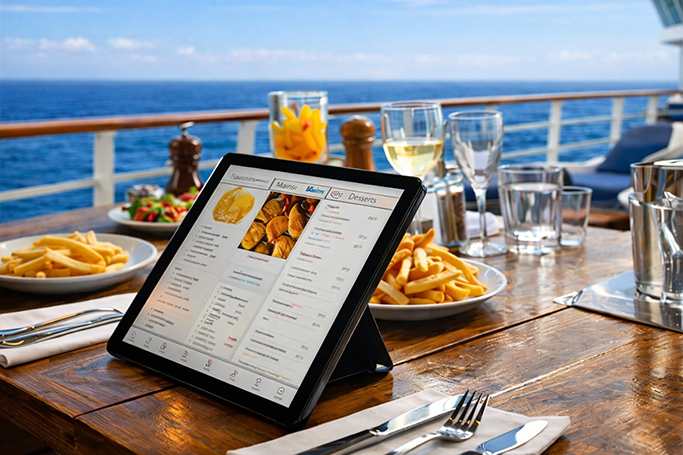
Digital menus powered by Servy are designed to function reliably onboard ships, supporting multiple venues, service styles, and guest journeys from a single system. Whether guests are browsing from their cabin, scanning a QR code at a poolside bar, or exploring options at a specialty restaurant, the experience feels unified.
Importantly, this technology does not replace human service. It removes friction so that crew members can focus on hospitality rather than logistics.
Connectivity at Sea Demands Smarter Systems
Cruise technology must respect one unavoidable truth: connectivity at sea is not always perfect.
Digital menus must load quickly, behave reliably, and remain usable even when bandwidth fluctuates. Guests should never feel like they are testing the ship’s internet while deciding what to order.
Servy is designed with these realities in mind, ensuring digital menus remain accessible and responsive throughout the voyage. Systems sync intelligently, maintaining accuracy without compromising user experience.
Reliability is not a feature. It is a requirement.
A Better Experience for a Global Guest Profile
Cruise guests come from all over the world, bringing diverse preferences, languages, and dietary needs. Managing this diversity with printed menus is challenging at best.
Digital menus allow cruise operators to:
– Clearly display dietary and allergen information
– Highlight vegetarian, vegan, halal, or gluten-free options
– Support multiple languages without clutter
– Adapt menu presentation by venue or time of day
This creates a dining experience that feels thoughtful rather than overwhelming. Guests feel informed without needing to ask. Crew members feel supported rather than stretched.
Small reductions in friction add up to meaningful improvements in guest satisfaction.
Contactless Dining Without Losing Warmth
Contactless dining became mainstream out of necessity, but it has remained relevant because of convenience.
On cruise ships, digital menus enable optional contactless interactions that speed up service in high-traffic venues like pool decks and casual dining areas. Guests who prefer traditional service still receive it, while those who value speed and autonomy can move at their own pace.
The key is choice. Cruise hospitality thrives when technology supports preference rather than forcing behavior.
Menus as a Canvas for Experience
Cruise dining is about storytelling. Destination-inspired dishes. Seasonal menus. Chef-driven concepts. These experiences deserve more than plain text.
Digital menus allow cruise lines to bring dishes to life with rich descriptions and visuals that reflect the journey itself. A menu becomes an extension of the cruise narrative rather than a static inventory list.
In specialty dining venues, this enhances perceived value. In casual venues, it simplifies decision-making. Across the ship, it elevates the overall dining experience.
Sustainability Through Smarter Design
Sustainability in the cruise industry is no longer optional. It is expected.
Printed menus contribute quietly to waste through frequent reprints and revisions. Digital menus significantly reduce this footprint while also enabling smarter planning. When operators understand what guests view, order, and skip, menus can be optimized to reduce overproduction and food waste.
This is sustainability driven by data rather than intention alone.
The Hidden Advantage: Data-Driven Cruise Operations
Every interaction with a digital menu generates insight.
Which items attract attention. Which perform best by venue or sailing route. Which dishes are consistently overlooked. Over time, these patterns inform better decisions across culinary planning, procurement, and staffing.
For cruise operators, this data transforms menus from static commitments into living feedback loops. Decisions become informed, not assumed.
This is where cruise technology delivers its quietest and most powerful advantage.
The Future of Dining at Sea
Cruise ships have always evolved by adopting technologies that genuinely improve operations and guest experience. Digital menus belong firmly in this tradition.
They create alignment between promise and delivery. Between guest expectations and onboard realities. Between operational control and hospitality warmth.
As cruise lines continue to modernize, digital menus will become a foundational element of cruise food and beverage technology. Not because they are new, but because they work.
Servy supports this evolution by enabling cruise operators to deliver clarity, consistency, and control without sacrificing the human touch that makes cruising memorable.
At sea, where every detail matters and every experience lingers long after the journey ends, the menu deserves to move with the ship, not lag behind it.