Hospitality has always evolved with guest behavior. But over the past few years, expectations haven’t just shifted — they’ve accelerated.
Today’s travelers, diners, and venue visitors expect the same speed, control, and convenience they get from eCommerce and mobile apps in every part of their journey. Waiting in line, handling paper receipts, or flagging down staff increasingly feels outdated.
Nowhere is this more visible than in US airports and large venues.
Passengers rushing between gates don’t want to stand in a 20-minute food line. Stadium guests don’t want to miss the game to order. Hotel and lounge visitors don’t want to wait for a server just to pay.
In 2026, convenience isn’t a “nice to have.” It’s the baseline.
For operators, this shift creates both pressure and opportunity. Those that modernize their service model are seeing measurable revenue gains. Those that don’t are watching guests bypass outlets altogether.
Here’s a clear look at the key hospitality trends shaping 2026 — and what they mean for airports, restaurants, and enterprise venues.
1. Self-Service Is Now the Default, Not the Alternative
What guests expect
Guests increasingly prefer:
– Ordering on their own device
– Skipping lines
– Paying digitally
– Controlling the pace of service
This behavior isn’t driven only by safety concerns anymore. It’s about efficiency.
If a traveler can order food from their phone while walking to Gate B12, why would they stand in line at a counter?
What this means for operators
Traditional service models can’t keep up with peak traffic. Staffing every counter isn’t scalable or cost-effective.
As a result, venues are moving toward:
– Mobile order & pay
– QR/NFC ordering at tables and seats
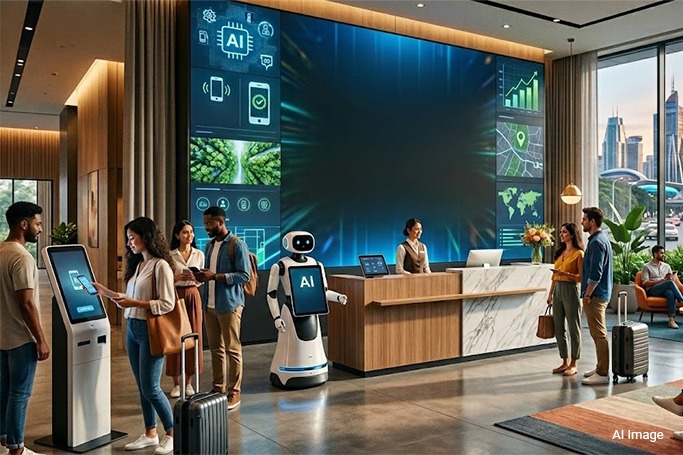
– Self-service kiosks
– Contactless checkout
Self-service doesn’t replace hospitality — it removes friction so staff can focus on preparation and guest support instead of transactions.
Where technology fits
Modern platforms enable:
– Device-based ordering without app downloads
– Location-specific QR or seat ordering
– Faster payments
– Fewer bottlenecks at POS
Solutions like Servy’s Order@ and self-service kiosks allow guests to order from anywhere while helping operators handle higher volumes without increasing labor costs.
2. Speed Is the New Currency of Guest Satisfaction
The reality in US airports
Airport dwell time is unpredictable.
Passengers:
– Arrive late
– Face security delays
– Board quickly
When time feels uncertain, they avoid queues entirely.
This leads to:
– Missed food purchases
– Lower per-passenger spend
– Frustration with airport services
The 2026 expectation
Guests expect:
– Immediate browsing
– One-tap checkout
– Quick pickup or delivery
– No waiting for checks
If ordering takes more than a few seconds, they simply skip it.
The operator opportunity
Faster ordering directly correlates with higher revenue.
Industry data consistently shows that digital ordering channels:
– Increase average ticket value
– Reduce abandoned purchases
– Improve throughput
When guests can order in under a minute, they’re more likely to buy.
Platforms that enable mobile ordering, kiosks, and multi-outlet discovery — such as digital marketplaces like Servy Marketplace — help convert “I don’t have time” into completed orders.
3. Labor Challenges Are Forcing Smarter Operations
The ongoing labor issue
The hospitality industry continues to face:
– Hiring shortages
– Rising wages
– High turnover
– Training costs
For airports and large venues, fully staffed counters simply aren’t sustainable anymore.
The 2026 shift
Operators aren’t trying to eliminate staff — they’re reallocating them.
Instead of:
❌ Taking orders
❌ Processing payments
Staff are focused on:
✅ Food preparation
✅ Order accuracy
✅ Delivery
✅ Guest support
Technology as a force multiplier
Digital ordering systems allow one team to serve more guests without compromising quality.
Self-service kiosks, device ordering, and centralized platforms reduce repetitive tasks and streamline workflows.
For many airports, adopting these tools isn’t just modernization — it’s operational survival.
4. Guests Expect a Unified, Omnichannel Experience
The problem with fragmented venues
Historically, airports and large venues operate like disconnected islands:
– Each outlet has separate menus
– Separate payment systems
– Separate queues
From a guest’s perspective, this feels inefficient.
The new expectation
Guests want:
– One place to browse all options
– One cart
– One checkout
– Clear discovery of nearby outlets
This mirrors how people shop online.
The rise of digital marketplaces
In 2026, more venues are adopting centralized ordering platforms that combine multiple brands into one interface.
This approach:
– Encourages cross-outlet ordering
– Increases average spend
– Reduces congestion
– Improves discoverability
Marketplace-style solutions — such as Servy’s Multi-Vendor Marketplace Technology — effectively turn an airport or venue into a digital food and retail hub rather than a collection of isolated counters.
5. Data Is Driving Every Business Decision
Then vs now
Previously, concessionaire performance relied on reported sales.
Today, operators demand:
– Real-time visibility
– Accurate POS data
– Sales benchmarking
– Revenue assurance
Why this matters
Airports generate significant revenue from non-aeronautical sources like dining and retail.
Without clear data:
– Underreporting goes unnoticed
– Opportunities are missed
– Planning becomes guesswork
The 2026 standard
Advanced analytics dashboards are becoming standard infrastructure.
These systems provide:
– Category performance
– Sales trends
– Outlet comparisons
– Revenue verification
Platforms such as Servy’s StoreSense retail analytics solution allow operators to monitor concessionaire performance with precision and make smarter operational decisions.
6. Contactless and Device-First Is Here to Stay
Contactless behavior isn’t temporary.
Guests now assume they can:
– Scan a QR
– Tap their phone
– Pay digitally
– Receive e-receipts
Paper menus and physical payment exchanges increasingly feel outdated.
Venues that still rely heavily on manual processes risk appearing behind the curve.
Digital-first interactions are becoming part of the overall brand perception of modern hospitality.
What This Means for Hospitality Leaders in 2026
If you manage an airport, restaurant group, or large venue, the message is clear:
Hospitality is no longer just about service quality.
It’s about service speed, flexibility, and digital convenience.
Winning operators will:
– Enable ordering anywhere
– Remove lines
– Optimize labor
– Centralize commerce
– Use data to drive revenue decisions
– Deliver seamless, contactless experiences
This isn’t a future trend. It’s already happening.
The Road Ahead
The venues that thrive in 2026 will treat digital infrastructure the same way they treat kitchens or seating — as core operations, not add-ons.
Modern hospitality technology platforms are becoming the foundation that connects:
– Guests
– Staff
– Concessionaires
– Payments
– Analytics
Solutions that combine mobile ordering, kiosks, marketplaces, and real-time insights into one ecosystem are increasingly becoming the standard.
For airports and hospitality operators, the question is no longer whether to modernize.
It’s how quickly they can do it.
Final Thoughts
Guest expectations will only continue to rise.
People expect hospitality to feel as simple as ordering from their phone at home.
The organizations that meet those expectations — through smarter service models, unified platforms, and frictionless ordering — will capture more revenue, improve satisfaction, and operate more efficiently.
In 2026, great hospitality isn’t just friendly service.
It’s invisible convenience.