Hospitality technology has a fragmentation problem.
Walk into most airports, stadiums, or large venues and you’ll find a patchwork of systems running behind the scenes.
One vendor handles kiosks.
Another manages POS.
A third provides mobile ordering.
Analytics live somewhere else.
Loyalty programs sit in yet another silo.
Individually, each tool works.
Together, they create complexity.
For operators, this means disconnected data, difficult integrations, and operational blind spots.
For guests, it means inconsistent experiences.
For partners and concessionaires, it means manual reporting and limited visibility.
The result? Friction everywhere.
And in modern hospitality, friction costs money.
Servy’s answer to this challenge isn’t another point solution.
It’s a platform.
The Servy Hub is designed to connect guests, operators, and partners through one unified ecosystem — transforming scattered tools into a seamless, scalable infrastructure for modern hospitality.
Why Hospitality Needs Platforms — Not More Tools
Over the past decade, hospitality operators have adopted digital solutions quickly.
But adoption often happened reactively:
“Add a kiosk to reduce lines.”
“Add mobile ordering because competitors have it.”
“Add analytics to track performance.”
Each decision solved a short-term problem.
But over time, this created a stack of disconnected technologies that don’t communicate well.
This creates several common challenges:
– Duplicate integrations with POS systems
– Inconsistent guest experiences across channels
– Fragmented reporting
– Higher maintenance costs
– Slow innovation
– Limited scalability
In high-volume environments like US airports or stadiums, these inefficiencies multiply fast.
A modern hospitality environment doesn’t need more tools.
It needs one system that orchestrates everything.
That’s the role Servy designed the Hub to play.
What Is the Servy Hub?
At its core, the Servy Hub is a centralized hospitality commerce platform.
Instead of treating mobile ordering, kiosks, payments, and analytics as separate systems, the Hub connects them into one integrated ecosystem.
Think of it as the operational backbone that powers every digital touchpoint across a venue.
Through one platform, operators can manage:
– Device-based ordering
– Self-service kiosks
– Multi-outlet marketplaces
– Payments
– POS integrations
– Loyalty connections
– Guest communications
– Analytics and reporting
All connected. All synchronized.
Instead of juggling vendors and interfaces, teams operate from one foundation.
How the Servy Hub Connects Guests
From a guest’s perspective, technology should feel invisible.
They don’t care about systems.
They care about speed and convenience.
The Servy Hub focuses on making ordering effortless no matter where a guest is.
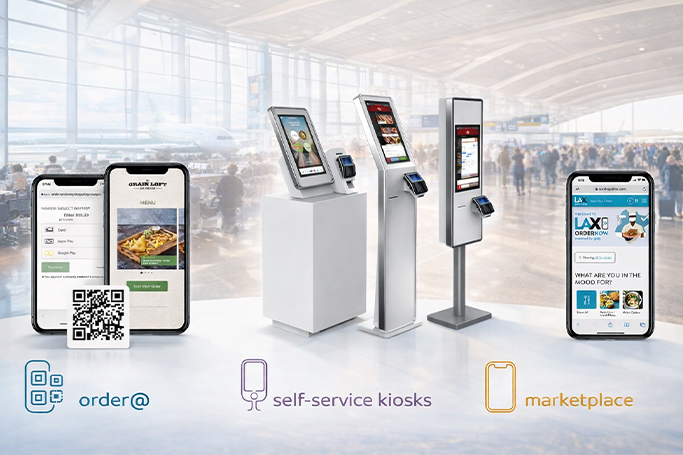
Device-first ordering
Guests can:
– Scan a QR code
– Tap NFC
– Browse menus instantly
– Order from their own phone
– Pay without downloading an app
This eliminates the biggest friction points: lines and waiting.
Self-service kiosks
For guests who prefer on-site screens, kiosks provide:
– Fast ordering
– Clear visuals
– Quick checkout
– High throughput
Marketplace discovery
Guests can browse multiple outlets in one place instead of hunting down options individually.
One cart. One checkout. Multiple brands.
Contactless payments and receipts
Digital-first transactions feel familiar, fast, and secure.
The result is a consistent experience across every touchpoint — whether guests are at a gate, a lounge, or a stadium seat.
It simply works.
How the Servy Hub Empowers Operators
Behind every smooth guest journey is complex coordination.
Operators need more than front-end tools. They need control and visibility.
The Servy Hub simplifies operations by centralizing management.
Single integration layer
Instead of integrating each system separately with POS, loyalty, and payment providers, Servy provides one connection point.
This reduces:
– Technical complexity
– Deployment time
– Maintenance overhead
Centralized control
Operators can manage:
– Menus
– Pricing
– Availability
– Promotions
– Locations
across multiple outlets from one interface.
Real-time analytics
The Hub provides immediate visibility into:
– Sales performance
– Peak demand times
– Item trends
– Outlet comparisons
– Guest behavior patterns
This enables smarter decisions around staffing, inventory, and revenue optimization.
Scalability
Adding new locations or partners doesn’t require rebuilding systems. The platform simply expands.
For enterprise environments like airports, this scalability is critical.
How the Servy Hub Supports Partners and Concessionaires
Hospitality ecosystems often involve multiple independent businesses operating under one roof.
Airports, for example, may host dozens or hundreds of concessionaires.
Traditionally, each operator runs its own systems.
This creates reporting headaches and limited visibility for the venue.
The Servy Hub brings everyone into one network.
Shared infrastructure
Concessionaires plug into the same platform for ordering and payments without replacing their POS.
Standardized reporting
Operators and venue managers gain accurate, real-time data across all outlets.
Revenue assurance
Centralized visibility ensures accurate sales tracking and invoicing.
Faster onboarding
New partners integrate quickly without heavy technical lift.
Tools like Servy’s analytics and retail dashboards make it easier for venues to understand performance across the entire ecosystem, not just individual stores.
This alignment benefits everyone:
– Guests get consistency
– Operators gain efficiency
– Partners increase visibility
Why a Unified Platform Matters More in Airports and Large Venues
In small environments, fragmented tools are inconvenient.
In airports or stadiums, they’re unsustainable.
These environments face:
– Massive daily traffic
– Time-sensitive guests
– Multiple vendors
– Complex contracts
– High expectations for speed
Disconnected systems create delays and blind spots.
A unified platform creates coordination.
For example:
Instead of:
Separate kiosk system + mobile vendor + reporting tool
Operators get:
One ecosystem that connects every transaction, every outlet, every guest interaction.
This is how venues scale efficiently without adding operational complexity.
From Transactions to Journeys
Perhaps the most important shift the Servy Hub enables is philosophical.
Traditional POS systems focus on transactions.
The Servy Hub focuses on journeys.
A transaction is a single moment: order and pay.
A journey includes:
– Discovery
– Browsing
– Ordering
– Payment
– Fulfillment
– Post-visit insights
Modern hospitality success depends on optimizing the entire journey, not just the checkout step.
By connecting every touchpoint, the Servy Hub ensures each part flows naturally into the next.
That’s what makes the experience feel seamless.
Built for Today — and Ready for What’s Next
Technology in hospitality won’t slow down.
Guest expectations will keep rising.
New payment methods, ordering behaviors, and operational needs will emerge.
Point solutions struggle to adapt because each change requires another integration.
Platforms evolve faster.
Because everything connects through one foundation, new capabilities can be added without disrupting the ecosystem.
That’s why Servy designed the Hub not just for today’s needs, but for long-term growth.
Final Thoughts
Hospitality is becoming more digital, more distributed, and more complex.
Managing that complexity with disconnected tools is increasingly difficult.
The future belongs to unified platforms that connect guests, operators, and partners in one seamless system.
That’s the role of the Servy Hub.
Not another app.
Not another kiosk.
But the infrastructure that brings everything together.
Because when hospitality runs on one connected platform, experiences feel simpler, operations feel smarter, and growth becomes easier.
And in modern hospitality, simplicity is the ultimate competitive advantage.