Across the US hospitality industry, one challenge keeps surfacing in every boardroom conversation, every operator meeting, and every quarterly forecast:
Staffing.
Restaurants can’t fill shifts fast enough.
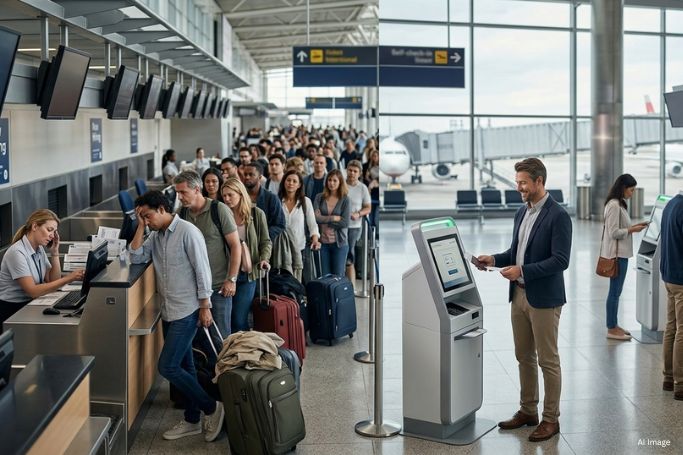
Airports struggle to fully staff peak hours.
Stadiums rely on temporary labor that changes every event.
Hotels and lounges stretch teams thinner than ever.
For years, labor was treated as a variable cost — something you could simply scale up or down.
Today, it’s become the biggest operational constraint.
And the pressure isn’t temporary.
Wage inflation, high turnover, seasonal demand spikes, and changing workforce expectations have fundamentally altered how hospitality businesses operate. Simply “hiring more people” is no longer a reliable solution.
As a result, many operators are reaching the same conclusion:
To maintain service levels and protect margins, hospitality must become smarter — not just bigger.
That’s where self-service and digital ordering come in.
Not as replacements for staff, but as force multipliers that help teams do more with less.
The Reality of Labor in Modern Hospitality
The labor environment in 2026 looks very different from a decade ago.
Across the US, operators face:
– Ongoing hiring shortages
– Rising minimum wages
– High employee turnover
– Increased training costs
– Unpredictable demand patterns
In high-traffic environments like airports and large venues, these issues are amplified.
You’re not just staffing a restaurant.
You’re staffing for thousands of guests moving through tight windows of time.
One delayed flight or halftime rush can overwhelm even a well-staffed location.
And when teams are short, service slows immediately.
Where Traditional Service Models Break Down
Most legacy hospitality operations were built around a simple assumption:
More guests = more staff.
If lines get longer, you add registers and cashiers.
But today, that model breaks down for several reasons.
1. You can’t hire fast enough
Labor pools are tighter than ever. Open positions stay unfilled for weeks.
2. Costs rise quickly
Adding staff increases payroll, benefits, and training expenses.
3. Demand isn’t steady
Peak periods last minutes or hours — not entire days. Overstaffing isn’t financially viable.
4. Turnover resets productivity
Constant retraining reduces efficiency and consistency.
This creates a no-win scenario:
– Understaff → slow service, lost sales
– Overstaff → high costs, low margins
Traditional staffing models simply aren’t flexible enough for modern hospitality environments.
The Hidden Costs of Being Understaffed
When teams are stretched thin, the impact shows up everywhere.
Slower service
Orders take longer to process. Lines grow. Guests abandon purchases.
Lower ticket sizes
Rushed guests order less and skip add-ons.
More errors
Overworked staff make mistakes, leading to remakes and waste.
Poor guest experience
Frustration replaces hospitality.
Staff burnout
High stress leads to higher turnover — making the labor problem worse.
This cycle is common across airports, quick-service restaurants, and venues alike.
And it directly affects both revenue and reputation.
Why Self-Service Is Emerging as the Smartest Solution
Forward-thinking operators aren’t trying to solve labor shortages by hiring more.
They’re redesigning operations so fewer staff are needed for transactional tasks.
The key shift:
Move ordering and payment to guests.
Move staff to preparation and service.
This approach allows teams to focus on what actually matters — food quality, fulfillment, and guest care — rather than repetitive processes like taking orders or handling payments.
Self-service doesn’t eliminate hospitality.
It eliminates bottlenecks.
How Self-Service Reduces Operational Strain
Modern self-service systems address staffing challenges in multiple ways at once.
1. Fewer cashiers required
Mobile ordering and kiosks handle transactions automatically.
2. Faster throughput
Orders are processed simultaneously, not sequentially.
3. Better staff allocation
Employees shift to back-of-house efficiency and fulfillment.
4. More predictable operations
Digital systems smooth out demand spikes.
5. Lower training burden
Staff focus on fewer, simpler tasks.
The result is leaner teams that still serve more guests.
What “Smarter Self-Service” Looks Like Today
Self-service in 2026 isn’t just a kiosk at the entrance.
It’s a connected ecosystem of tools that work together.
Device-based ordering
Guests scan a QR or tap NFC to order directly from their phones — no app required.
Self-service kiosks
High-traffic ordering stations that reduce counter congestion.
Digital marketplaces
Centralized platforms where guests browse multiple outlets and order in one place.
Real-time analytics
Data that helps operators optimize staffing and performance.
Together, these systems distribute ordering across hundreds or thousands of touchpoints instead of a few registers.
This dramatically reduces pressure on staff.
Platforms like Servy’s integrated ordering ecosystem combine all these elements — enabling operators to scale service without scaling labor at the same rate.
Real-World Impact: Airports and Large Venues
Labor strain is particularly intense in airports and stadiums.
Airports
Passenger traffic comes in waves:
– Morning departures
– Lunch rushes
– Weather delays
– Holiday peaks
Staffing for worst-case demand isn’t realistic.
But self-service allows guests to order:
– At gates
– In lounges
– While walking
– From anywhere in the terminal
This reduces the need for front-of-house staffing at every outlet.
Stadiums and arenas
Halftime or intermission creates massive demand spikes.
Traditional counters can’t handle thousands of orders simultaneously.
Seat-based or mobile ordering spreads demand out and reduces counter pressure.
In both cases, self-service turns fixed capacity into flexible capacity.
Self-Service Also Improves Revenue, Not Just Efficiency
Some operators worry that automation reduces the “hospitality” feel.
In practice, the opposite happens.
When staff aren’t overwhelmed with transactions, they can:
– Deliver faster
– Focus on quality
– Engage more meaningfully with guests
At the same time, digital ordering typically increases revenue through:
– Higher average tickets
– Suggestive selling
– Fewer abandoned purchases
– Faster throughput
So operators gain both efficiency and profitability.
It’s rare to find solutions that improve both simultaneously — which is why self-service adoption is accelerating so quickly.
Addressing the Biggest Misconception
One common myth is:
“Self-service replaces staff.”
In reality, it rebalances roles.
Instead of:
❌ Taking orders
❌ Swiping cards
❌ Printing receipts
Staff focus on:
✅ Preparing food
✅ Ensuring accuracy
✅ Delivering orders
✅ Supporting guests
Hospitality becomes more human, not less.
Technology handles the repetitive work.
People handle the experience.
What Hospitality Leaders Should Be Considering Now
If labor shortages continue — and all signs suggest they will — operators need more than short-term fixes.
They need structural changes.
Questions leaders should ask:
– Can guests order without staff assistance?
– Can we handle peak demand without adding labor?
– Do we rely too heavily on counters?
– Do we have visibility into performance and staffing needs?
– Are our systems flexible enough to scale?
If the answer is no, it may be time to rethink the operational model.
The Road Ahead
Hospitality isn’t becoming less human.
It’s becoming smarter.
Self-service, kiosks, mobile ordering, and unified platforms are helping operators:
– Reduce staffing pressure
– Improve efficiency
– Increase revenue
– Deliver better guest experiences
All without sacrificing service quality.
In an industry where labor challenges are unlikely to disappear, smarter self-service isn’t just helpful.
It’s becoming essential infrastructure.
Final Thoughts
Labor shortages aren’t a temporary disruption. They’re a long-term operational reality.
The businesses that adapt will thrive.
Those that rely on traditional staffing models will struggle.
By combining digital ordering, self-service, and connected technology platforms, hospitality operators can build environments that serve more guests with fewer bottlenecks — and less strain on their teams.
Because the future of hospitality isn’t about working harder.
It’s about working smarter.